
Light Spectrum Impact on Plant Morphology and Resilience

Light Spectrum Impact on Plant Morphology and Resilience.
Light spectrum directly controls plant morphology and resilience. Plants sense specific wavelengths through photoreceptors, then adjust their height, leaf structure, and stem strength in response. Sollum Technologies builds dynamic LED systems that shift the spectrum across each growth stage, giving growers precise control over plant and stress tolerance.
Every greenhouse crop reads light as information, not just energy. A tomato seedling under blue-rich light grows short and sturdy. The same seedling under far-red-rich light stretches tall and thin. This response happens because plants evolved to sense their light environment and change shape to match it. For commercial growers, this biology is a practical lever. The right spectrum produces compact transplants, stronger stems, better fruit quality, and crops that resist stress. This article explains how each wavelength band shapes plant structure, how spectrum builds resilience, and why dynamic control outperforms fixed lighting.
How Does Light Spectrum Change Plant Morphology?
Plants change morphology through photomorphogenesis, the process where light signals guide development. Specialized photoreceptors detect specific wavelengths and trigger changes in stem length, leaf size, branching, and flowering. This response works separately from photosynthesis, so spectrum shapes plant form even at low light intensities.
Photomorphogenesis relies on three main photoreceptor families. Phytochromes detect red and far-red light and act as the primary switch for stem extension and flowering. Cryptochromes sense blue light and drive compact growth and leaf thickness. Phototropins also respond to blue light and control how plants bend toward a light source and open their stomata.
These receptors work together as a sensing system. When a plant detects a spectrum that signals crowding or shade, it redirects energy into vertical growth to reach better light. When it detects open, blue-rich light, it invests in thick leaves and short internodes instead. Growers control the spectrum, rather than leaving plant shape to chance.
Which Wavelengths Control Plant Shape?
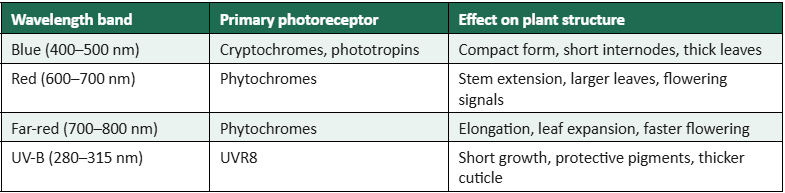
Blue light produces compact plants with short internodes and thick leaves. Red light promotes stem extension and larger leaf area. Far-red light triggers elongation and faster flowering. UV-B light creates short, hardened growth. Each band sends a distinct structural signal that growers combine for a target plant form.
The red-to-far-red ratio (R:FR) is the strongest single control over plant height. A high R:FR ratio, with more red than far-red, signals open conditions and keeps plants compact. A low R:FR ratio, with more far-red, triggers the shade-avoidance response: stems elongate, leaves expand, and flowering often accelerates. Growers adjust this ratio to manage crop height without chemical growth regulators. This far-red light strategy matters most for tall fruiting crops such as tomatoes and peppers, where excess height wastes energy and adds labor.
The table below summarizes how each band shapes plant structure
How Does Spectrum Build Plant Resilience?
Spectrum builds resilience by triggering protective compounds inside the plant. Blue and UV-B light prompt crops to produce flavonoids, anthocyanins, and phenolic compounds. These molecules act as antioxidants, sun screens, and pest deterrents. They also improve firmness and post-harvest quality, though the effect on disease resistance varies by crop and dose.
Resilience starts at the cellular level. When a plant senses UV-B light, its UVR8 photoreceptor activates genes that build protective pigments. Flavonoids and anthocyanins absorb excess radiation and neutralize the reactive molecules that damage plant tissue. The same compounds deepen fruit color, sharpen flavor, and raise the nutritional value that buyers reward. Lettuce growers use this effect to intensify red-leaf color, and strawberry growers use it to raise the anthocyanin content that improves both appearance and antioxidant value.
Structure adds a second layer of protection. Blue and UV-B light produce compact plants with thicker leaves and firmer tissue. This sturdier growth handles temperature swings, physical handling, and transport with less damage. A hardened plant reaches the buyer in better condition and holds quality longer on the shelf.
Growers use this response as a finishing step. A short spectrum shift near harvest raises pigment levels and strengthens tissue right before crops leave the greenhouse. This method improves grade and shelf life without extra inputs.
Why Static Lighting Limits Morphological Control
Static LED and HPS lights fix the spectrum at installation, so they cannot match plant needs across growth stages. A seedling, a vegetative plant, and a flowering crop each require a different spectral balance. Fixed lighting forces one compromise recipe on every stage, which limits both plant quality and yield.
Greenhouse crops move through distinct phases, and each phase responds to a different spectrum. Propagation benefits from blue-rich light that produces compact, sturdy transplants. Vegetative growth needs a balance that builds leaf area and biomass. Flowering and fruiting often improve with added far-red and adjusted ratios. A static fixture holds one spectrum for all three, so growers lose control at every transition.
The technology path makes the gap clear. Growers first moved from HPS to static LED to cut energy use and heat. Static LED improves efficiency, yet it still locks the spectrum in place. Dynamic LED completes the transition by making the spectrum adjustable in real time. Only dynamic control lets a grower match the exact spectral recipe to each stage and each zone.
What Dynamic Spectrum Control Means for Growers
Dynamic spectrum control lets growers program the exact light recipe for each crop and each growth stage. The SUN as a Service platform from Sollum Technologies adjusts spectrum and intensity across multiple zones at once. Growers shape plant morphology, strengthen resilience, and protect yield from a single system.
Dynamic control turns spectrum science into a daily production tool. A grower runs a blue-rich recipe to produce compact seedlings, shifts the ratio to build vegetative mass, then adds far-red to support flowering. A short blue or UV finish near harvest raises pigment and firmness. Multi-zone management runs several of these recipes in the same greenhouse at the same time. The platform records each recipe and its result, so growers refine their spectral strategy with production data rather than guesswork.
The commercial results support the approach. Sollum's case studies have documented a 19.5% increase in tomato yield and a 54% increase in Class I (top-grade) strawberry yield with dynamic recipes. These gains come from matching light to plant biology at every stage, rather than accepting one fixed spectrum.
To apply spectrum control in your own operation:
- Map each crop's growth stages and the plant form you need at each one.
- Set a blue-rich recipe for propagation to produce compact, sturdy transplants.
- Manage the red-to-far-red ratio to control height without growth regulators.
- Apply a short blue or UV finish near harvest to raise color, firmness, and shelf life.
Sollum Technologies works with growers and research partners to build recipes matched to each crop and climate.

Frequently Asked Questions
What light color makes plants grow compact and bushy?
Blue light makes plants grow compact and bushy. Blue wavelengths activate cryptochrome photoreceptors, which shorten the internodes and thicken the leaves. Growers apply blue-rich light during propagation to produce sturdy, uniform transplants that resist stretching and handle the stress of transplanting well.
How does the red to far-red ratio affect plant height?
The red-to-far-red ratio controls plant height through phytochrome photoreceptors. A high ratio, with more red light, keeps plants compact. A low ratio, with more far-red light, triggers shade-avoidance elongation and stretches stems. Growers adjust this ratio to manage height without chemical growth regulators.
Can light spectrum improve a plant’s stress tolerance?
Yes, light spectrum improves stress tolerance. Blue and UV-B light prompt plants to produce flavonoids and anthocyanins, which act as antioxidants and protect tissue. These wavelengths also support firmer tissue and better post-harvest quality, though the effect on disease resistance varies by crop and dose.
Why can’t static LED lights control plant morphology across growth stages?
Static LED lights fix the spectrum at installation, so they deliver one spectral recipe to every growth stage. Seedlings, vegetative plants, and flowering crops each need a different balance. Dynamic LED systems change the spectrum in real time, which static fixtures cannot do.
Match the Spectrum to the Crop
Light spectrum shapes plant morphology and resilience at every stage of growth. Blue light builds compact, sturdy plants, the red-to-far-red ratio sets height, and UV-B strengthens tissue and color. Fixed lighting cannot follow these needs across a crop cycle, while dynamic spectrum control can. If you want to shape plant form and resilience with precision, Sollum Technologies can help you design recipes matched to your crops.
Learn about the new energy savings feature
About Sollum Technologies
As the leader in advanced dynamic LED lighting for commercial greenhouses, Sollum Technologies offers a unique proposition. The comprehensive solution provides the flexibility to adapt lighting in real time to meet crop needs at every stage of growth, supports producers operational and financial goals in a sustainable manner, and offers unmatched technical and agronomic guidance. Designed and manufactured in North America, Sollum's technology is deployed across major greenhouse operations to support year-round production, consistent quality, and smarter energy use.
Founded in 2015, Sollum is headquartered in Montréal (Québec, Canada) with regional offices in Kingsville (Ontario, Canada) and Atlanta (Georgia, USA). For more information, visit sollum.tech.

Stay informed on growing
Get the latest news, innovations, and insights delivered to your inbox

