
Which LED Lights Offer Full-Spectrum Control for Crops?
Static “full spectrum” is a spec. Spectrum control is a strategy.
Full-spectrum LED lighting has become the standard in horticulture. Most modern fixtures claim to offer it. However, the question has shifted. Rather than asking whether a light can offer a full spectrum, growers are now asking how that spectrum can be controlled, adjusted, and applied in real greenhouse conditions.
In previous discussions, including our article Full Spectrum Isn’t Enough, we explored why spectrum alone does not guarantee results. This article further develops this idea by examining how different LED lighting systems approach spectrum control, and its impact crop performance over time.
Because when it comes to lighting, access to wavelengths is only the beginning. What matters is how growers use the different wavelengths to induce specific plant responses.
What “Full Spectrum” Really Means for Crops
In horticulture, full-spectrum LED lighting generally refers to light that covers the wavelengths plants use for photosynthesis and development, primarily within the PAR range (400–700 nm). It increasingly includes far-red (700–750 nm) and, in some applications, UV wavelengths for more advanced crop steering.

This broad spectral coverage supports essential plant functions, including
- Photosynthesis
- Morphology and structural development
- Flowering and fruiting responses
However, crops do not respond to light in a consistent manner. Their needs evolve based on the species, the growth stage, the season, and the surrounding environment. A spectrum that is effective at one time may be less so at another.
This is why full-spectrum LEDs alone do not define lighting performance.
Spectrum Availability vs. Spectrum Control
Many LED fixtures provide a broad spectral output. Far fewer allow growers to actively manage how that spectrum is delivered over time. In commercial greenhouses, lighting decisions are influenced by:
- Daily and seasonal variations in natural light
- Changing crop requirements throughout the growth cycle
- Operational considerations such as energy efficiency and consistency
When lighting remains static, growers often must adapt their crops to it. With spectrum control, the lighting adapts to the crops, not the other way around.
Comparing the Three Types of Full-Spectrum LED Technologies
Most full-spectrum LED lighting systems used in horticulture today fall into one of three general categories.
- Fixed Full-Spectrum LEDs
These fixtures deliver a predefined spectral output designed to offer crops a generic spectrum.
Once installed, the spectrum remains unchanged. This approach is simple to manage and can be sufficient for basic monocultures. However, it quickly becomes a bottleneck for higher-value crops, such as vine crops, strawberries or medicinal plants, where steering specific traits like internode length, flowering response, or secondary metabolites is critical to profitability.
- Multi-Channel LEDs With Manual Adjustment
Some LED systems allow growers to adjust individual channels, such as red, blue, or white light. These changes are typically made through presets or manual controls. While this offers more flexibility than fixed-spectrum lighting, adjustments are often:
- Applied uniformly across large growing areas
- Made periodically rather than continuously
For example, a grower may increase blue light during propagation to promote compact rooting or introduce more far-red during fruiting to encourage generative growth. However, when these adjustments require manual intervention and broad application, spectrum control remains limited.
- Advanced Dynamic Full-Spectrum LEDs
More recent lighting systems are designed to adjust spectrum and intensity dynamically. Rather than relying on static recipes, lighting strategies evolve based on predefined targets or operational needs.
This approach makes it possible to:
- Adapt lighting to the plant's growth stage.
- Respond to seasonal changes in natural daylight
- Manage lighting at a more granular level, including by zone
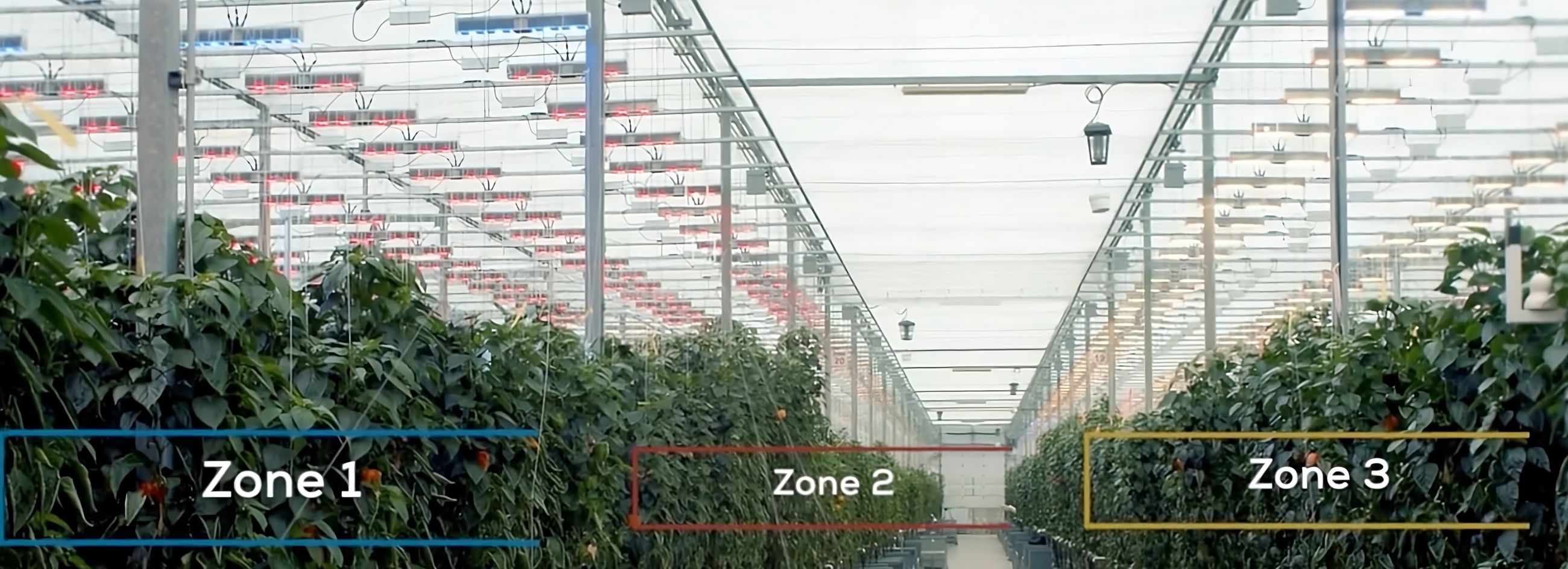
Here, the spectrum serves as an operational lever, rather than a technical specification. For example, adding blue light during propagation encourages compact root growth, and using far-red light promotes generative growth during fruiting.
What Full-Spectrum Control Looks Like in Practice
For growers, meaningful spectrum control is not about adding complexity.It is about alignment and automation. Advanced systems automatically execute dynamic light recipes based on sensor data, ensuring precision without adding manual interventions to the grower’s daily workload.
In practice, this can include:
- Managing spectrum and intensity together to support daily light integral (DLI) targets
- Adjusting lighting strategies as daylight availability changes throughout the year
- Tailoring light delivery to different crops or zones within the same greenhouse facility
The objective is to achieve consistent crop performance, even when external conditions are variable.
Questions to Ask When Evaluating Full-Spectrum LED Lights

When comparing full-spectrum LED lighting systems, growers may want to ask:
- Is the spectrum fixed, adjustable through presets, or continuously controlled?
- Can spectrum adjustments be made independently in each zone?
- How does the system adapt to different crop stages or seasonal conditions?
- Can spectrum and intensity be managed together as part of a broader lighting strategy?
These questions help steer the conversation beyond specifications and toward long-term operational value.
From Full Spectrum to Full Control
Today, full-spectrum LED lighting is no longer a differentiator. It is the starting point.
What increasingly defines effective lighting strategies is the ability to control and adapt spectrum in real-world growing conditions. As greenhouse operations become more complex and more data-driven, lighting systems must offer flexibility, precision, and the ability to evolve alongside the operation.
For growers, the path is clear. The future of horticultural lighting lies beyond providing light. It is about using light intentionally, aligned with th ecrop, the season, and the realities of day-to-day production.
Are you ready to learn more about how Sollum’s advanced dynamic LED can transform your crop production? Get in touch with our team or call 1-866-220-5455 to get started.
Learn about the new energy savings feature
About Sollum Technologies
As the leader in advanced dynamic LED lighting for commercial greenhouses, Sollum Technologies offers a unique proposition. The comprehensive solution provides the flexibility to adapt lighting in real time to meet crop needs at every stage of growth, supports producers operational and financial goals in a sustainable manner, and offers unmatched technical and agronomic guidance. Designed and manufactured in North America, Sollum's technology is deployed across major greenhouse operations to support year-round production, consistent quality, and smarter energy use.
Founded in 2015, Sollum is headquartered in Montréal (Québec, Canada) with regional offices in Kingsville (Ontario, Canada) and Atlanta (Georgia, USA). For more information, visit sollum.tech.

Stay informed on growing
Get the latest news, innovations, and insights delivered to your inbox
